
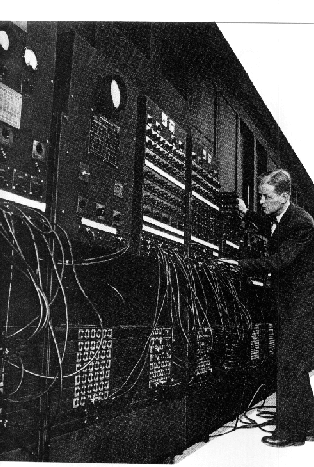
The First Computer
When discussing the history of computers, one cannot overlook the significance of the first computer ever created. The origins of the first computer can be traced back to the early 19th century.
Charles Babbage, an English mathematician, is often credited with conceptualizing the first mechanical computer known as the “Analytical Engine.” Although Babbage never completed the construction of this machine, his ideas laid the foundation for modern computing.
It wasn’t until the mid-20th century that the world saw the development of electronic computers. The Electronic Numerical Integrator and Computer (ENIAC), completed in 1945, is often considered one of the first electronic general-purpose computers. ENIAC was a massive machine that filled an entire room and was used for complex calculations.
Following ENIAC, other pioneering computers such as UNIVAC and IBM’s Harvard Mark I further advanced computer technology. These early computers paved the way for the digital revolution that would transform society in the decades to come.
Looking back at the evolution of computers, it is fascinating to see how far we have come since the creation of the first computer. Today’s computers are not only significantly smaller and more powerful but also integral to almost every aspect of modern life.
The journey from Charles Babbage’s Analytical Engine to today’s smartphones and supercomputers is a testament to human ingenuity and innovation in the field of computing.
9 Fascinating Facts About ENIAC: The World’s First Computer
- The first computer was called the ENIAC.
- ENIAC stands for Electronic Numerical Integrator and Computer.
- It was developed during World War II in the 1940s.
- ENIAC used vacuum tubes for processing data.
- It weighed about 30 tons and took up a large room.
- Programming ENIAC involved physically rewiring its circuits.
- ENIAC could perform calculations much faster than humans.
- The development of ENIAC marked a significant milestone in computer history.
- Today’s computers have evolved significantly from the first computer.
The first computer was called the ENIAC.
The first computer, known as the ENIAC (Electronic Numerical Integrator and Computer), marked a significant milestone in the history of computing. Completed in 1945, the ENIAC was one of the earliest electronic general-purpose computers and represented a leap forward in computational capabilities. Its massive size and complex architecture paved the way for future advancements in computer technology, setting the stage for the digital revolution that would shape the modern world.
ENIAC stands for Electronic Numerical Integrator and Computer.
The acronym ENIAC stands for Electronic Numerical Integrator and Computer. ENIAC, completed in 1945, is considered one of the first electronic general-purpose computers. This groundbreaking machine marked a significant milestone in the history of computing, showcasing the potential of electronic technology to revolutionize complex calculations and data processing.
It was developed during World War II in the 1940s.
During World War II in the 1940s, significant advancements were made in the field of computing, leading to the development of the first electronic general-purpose computer. This period saw the creation of groundbreaking machines like the Electronic Numerical Integrator and Computer (ENIAC), which played a crucial role in complex calculations and data processing during wartime. The development of the first computer during this tumultuous era marked a pivotal moment in history, setting the stage for the digital revolution that would follow in the decades ahead.
ENIAC used vacuum tubes for processing data.
The Electronic Numerical Integrator and Computer (ENIAC), one of the first electronic general-purpose computers, utilized vacuum tubes for processing data. These vacuum tubes served as the basic building blocks of ENIAC’s electronic circuitry, allowing for the manipulation and computation of numerical data. Despite their size and tendency to generate heat, vacuum tubes were a crucial component in early computer technology, enabling ENIAC to perform complex calculations at a speed previously unimaginable. The use of vacuum tubes in ENIAC marked a significant milestone in the history of computing, paving the way for further advancements in electronic computing systems.
It weighed about 30 tons and took up a large room.
The first computer, known as the Electronic Numerical Integrator and Computer (ENIAC), was a behemoth of a machine, weighing about 30 tons and occupying a large room. Its sheer size and weight were a testament to the early days of computing when technology was still in its infancy. Despite its massive footprint, ENIAC represented a significant leap forward in computational capabilities and laid the groundwork for future advancements in the field of computing.
Programming ENIAC involved physically rewiring its circuits.
Programming ENIAC, one of the first electronic general-purpose computers, was a labor-intensive process that involved physically rewiring its circuits. Unlike modern computers that can be programmed using software, ENIAC required technicians to manually reconfigure its wiring to perform different tasks. This hands-on approach to programming highlights the stark contrast between early computing methods and the streamlined programming techniques used today.
ENIAC could perform calculations much faster than humans.
The Electronic Numerical Integrator and Computer (ENIAC) represented a groundbreaking advancement in computing technology, as it could perform calculations at a speed far surpassing that of human capabilities. Designed and completed in 1945, ENIAC’s ability to process complex numerical tasks with remarkable speed revolutionized the way calculations were performed. Its capacity to execute computations at a much faster rate than humans not only increased efficiency but also opened up new possibilities for scientific research, engineering, and various other fields that relied on precise and rapid calculations. ENIAC’s exceptional speed and computational power marked a significant milestone in the history of computing, setting the stage for further advancements in technology that would shape the modern world.
The development of ENIAC marked a significant milestone in computer history.
The development of ENIAC marked a significant milestone in computer history. Completed in 1945, the Electronic Numerical Integrator and Computer (ENIAC) is widely recognized as one of the first electronic general-purpose computers. ENIAC’s completion represented a leap forward in computing technology, showcasing the potential for electronic machines to perform complex calculations at unprecedented speeds. This groundbreaking achievement laid the foundation for further advancements in computer science and set the stage for the digital revolution that would shape the modern world.
Today’s computers have evolved significantly from the first computer.
Today’s computers have come a long way from the first computer created in the early 19th century. The evolution of computing technology has been remarkable, with modern computers being smaller, faster, and more powerful than ever before. From the massive machines like ENIAC to the sleek laptops and smartphones we use today, the progress in computer technology is truly astounding. This transformation highlights the continuous innovation and advancements in the field of computing, shaping the way we live, work, and communicate in the digital age.