
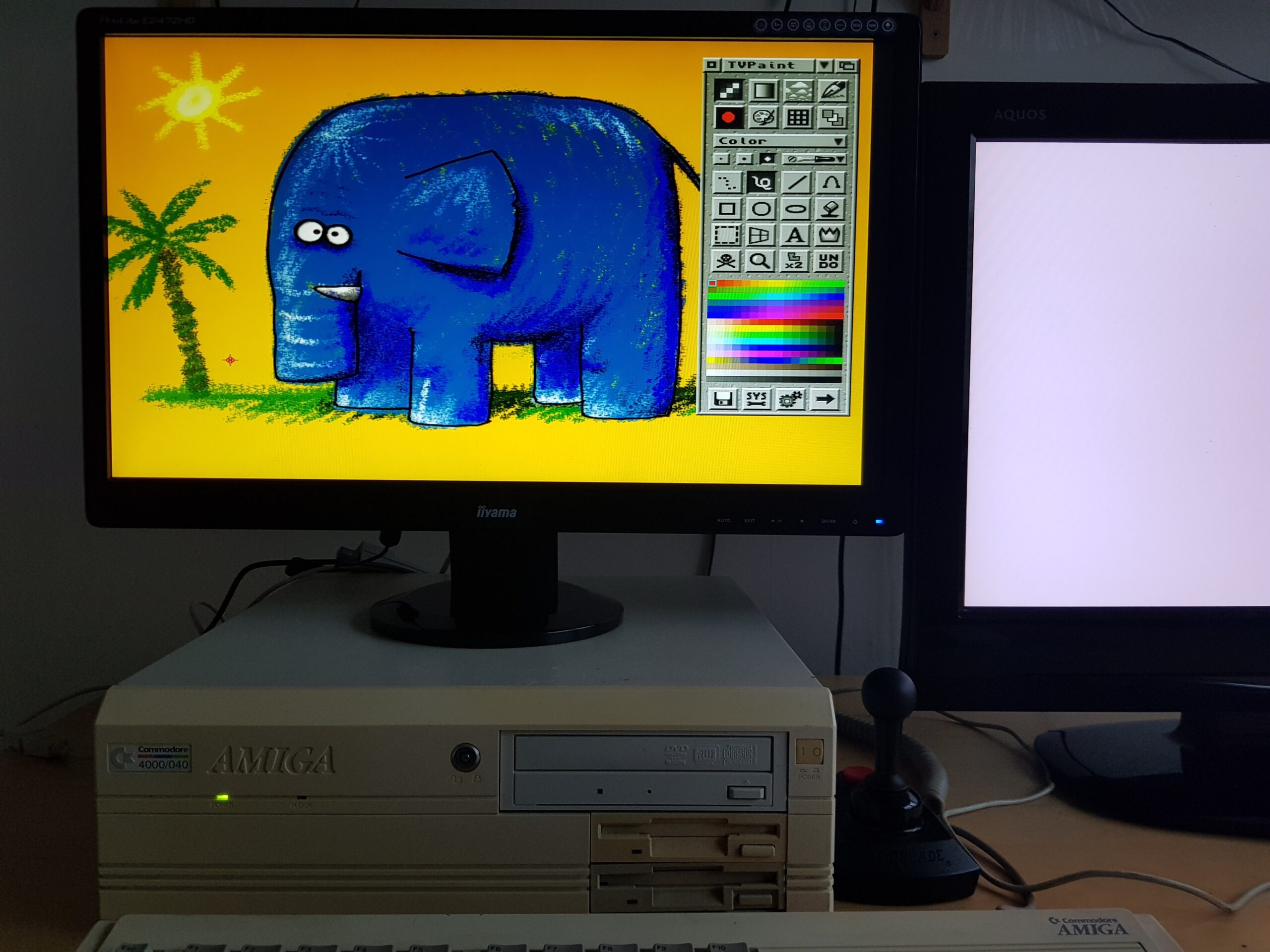
Amiga 4000: Commodore’s High-End Amiga
Introduced in 1992, the Amiga 4000 was Commodore’s flagship Amiga computer. It brought the Amiga line’s multimedia strengths into the 1990s with a faster processor, an updated graphics chipset, and room for expansion. Aimed at creative professionals and demanding home users, the A4000 became one of the best-known high-end Amiga systems.
A New Generation of Amiga
The A4000 was built around Commodore’s Advanced Graphics Architecture, or AGA. AGA expanded the Amiga’s color capabilities, displaying up to 256 colors from a palette of more than 16 million. In special modes, including HAM8, it could show many more colors at once. These features made the computer useful for image editing, animation, video work, and games.
The system was initially offered as the A4000/040, featuring a 25 MHz Motorola 68040 processor. A more affordable A4000/030, with a 25 MHz Motorola 68030, followed. Both models ran AmigaOS 3.0, pairing the new hardware with an updated operating system.
Memory and Expansion
The A4000 came with 2 MB of Chip RAM, which the processor and custom Amiga chips could share. It also supported additional Fast RAM, giving users more memory for applications and multitasking. Expansion options included Zorro III slots for add-on cards, as well as other connections for graphics, storage, and peripherals. This flexibility allowed owners to tailor the computer for tasks such as video production, networking, or professional graphics.
Like earlier Amigas, the A4000 combined general-purpose computing with dedicated hardware for graphics and sound. Its internal IDE interface and floppy drive supported common storage needs, while its expansion slots offered a path to newer or specialized equipment.
Desktop and Tower Models
The original A4000 came in a desktop case designed to sit beneath a monitor. A tower version, the Amiga 4000T, appeared later, offering a larger case and additional room for drives and expansion cards. The tower model became especially appealing to users building more elaborate systems.
Legacy
The Amiga 4000 arrived during a difficult period for Commodore, and the company went bankrupt in 1994. Despite those circumstances, the A4000 remained an important platform for Amiga enthusiasts and creative users. Its AGA graphics, 32-bit architecture, and expandability made it a capable machine for its era.
Today, the Amiga 4000 is remembered as one of Commodore’s most ambitious computers. It represents the company’s effort to carry the Amiga platform into a new generation—and remains a favorite among collectors, restorers, and people who continue to use classic Amiga hardware.
Amiga 4000 FAQs: Specifications, Models, Operating System, Memory, and Upgrades
- What are the specifications of the Amiga 4000?
- What is the difference between the Amiga 4000/030 and Amiga 4000/040?
- What operating system does the Amiga 4000 use?
- How much memory can the Amiga 4000 support?
- Can the Amiga 4000 still be used or upgraded today?
What are the specifications of the Amiga 4000?
The Amiga 4000’s specifications vary by model, but it was generally equipped with a 25 MHz Motorola 68040 processor in the A4000/040 or a 25 MHz 68030 in the A4000/030, along with Commodore’s AGA graphics chipset. AGA could display up to 256 colors from a palette of more than 16 million, with additional high-color modes. The system included 2 MB of Chip RAM, additional Fast RAM depending on configuration, four-channel 8-bit stereo sound, a built-in floppy drive, and an IDE interface for a hard drive. It also ran AmigaOS 3.0 and offered expansion options including Zorro III slots.
What is the difference between the Amiga 4000/030 and Amiga 4000/040?
The main difference is the processor: the Amiga 4000/030 uses a 25 MHz Motorola 68030, while the Amiga 4000/040 has a 25 MHz 68040, which generally delivers faster performance and includes an integrated floating-point unit and memory management unit. Both models share the AGA graphics chipset and broadly similar core features, but the /040 is better suited to processor-intensive tasks such as 3D rendering and advanced image work. Some older software may need compatibility settings or updates to run properly on the 68040.
What operating system does the Amiga 4000 use?
The Amiga 4000 originally shipped with AmigaOS 3.0, Commodore’s operating system for the Amiga line. Depending on the model and later updates, it can also run newer Amiga-compatible systems, including AmigaOS 3.1 and 3.2, as well as alternatives such as MorphOS or AROS on supported hardware.
How much memory can the Amiga 4000 support?
The Amiga 4000 supports up to 18 MB of memory on its motherboard: 2 MB of Chip RAM and up to 16 MB of Fast RAM using its SIMM slots. The total can be increased with compatible processor-card or Zorro expansion-board memory, so upgraded systems can hold considerably more than the standard motherboard limit.
Can the Amiga 4000 still be used or upgraded today?
Yes. The Amiga 4000 can still be used today, and a range of upgrades can improve its performance and usability. Depending on the model and configuration, owners can add memory, accelerator cards, modern storage such as CompactFlash or SD solutions, and graphics or networking expansions. It can also run updated Amiga software, including newer versions of AmigaOS, though compatibility varies by hardware and setup. Because these machines are decades old, check the power supply, capacitors, and other components before regular use, and confirm that any upgrade is compatible with your specific A4000.