
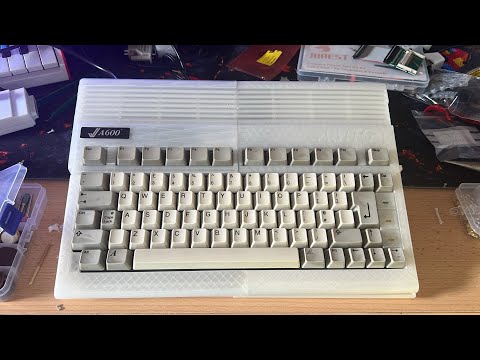
Amiga 600: A Compact Member of the Amiga Family
The Amiga 600, often called the A600, was a compact home computer introduced by Commodore in 19
It brought the familiar Amiga experience to a smaller case, adding built-in storage options and a PCMCIA expansion slot. Although it retained much of the Amiga 500’s core hardware, its design choices made it a distinctive—and sometimes controversial—model.
Hardware and design
At the heart of the A600 was a Motorola 68000 processor, running at approximately 7 MHz. The computer typically came with 1 MB of Chip RAM, which could be expanded to 2 MB, and used the Enhanced Chip Set (ECS). Its graphics and sound capabilities were characteristic of the Amiga platform, including support for colorful graphics modes and four-channel sampled audio.
The A600’s most obvious difference from the Amiga 500 was its smaller keyboard and case. Commodore removed the numeric keypad and the Amiga 500’s large side expansion connector. The smaller footprint made the computer easier to fit into a home setup, but the reduced keyboard and limited expansion options disappointed some users who expected a straightforward upgrade to the A500.
Storage and expansion
One important addition was an internal 2.5-inch IDE interface, which allowed a hard drive to be installed inside the computer. Commodore also sold the Amiga 600HD, a version supplied with a hard drive. The A600 included a PCMCIA Type II slot, which could be used with compatible memory cards and other peripherals.
These features gave the A600 a more modern feel than many earlier home computers. However, its compact design meant that upgrades and add-ons did not always have the same flexibility as those available for the Amiga 5
Compatibility also varied: some older Amiga programs expected hardware features or keyboard keys that the A600 did not provide.
Software and compatibility
The A600 shipped with Kickstart 2.05 and was designed to run AmigaOS 2.
This operating system offered a more polished interface than the earlier Workbench versions commonly associated with the Amiga 500. The machine could run a wide range of Amiga applications and games, but some older titles were incompatible or required workarounds. The A600 was not an AGA computer; it used ECS rather than the later Advanced Graphics Architecture found in models such as the Amiga 1200.
Reception and legacy
The Amiga 600 occupies an unusual place in Commodore history. Its small size, IDE support, and PCMCIA slot made it a capable and convenient computer, particularly for users who wanted a compact system with internal storage. At the same time, the missing numeric keypad and removal of the A500’s side expansion connector made it feel like a compromise to some Amiga owners.
Today, the A600 remains a popular subject among collectors and retro-computing enthusiasts. Its compact design and built-in expansion options make it an interesting example of Commodore’s effort to refresh the Amiga line during the early 1990s.
Amiga 600 FAQ: Specs, Memory, Storage, Compatibility, and Modern Display Connections
- What is the Amiga 600?
- When was the Amiga 600 released?
- What are the Amiga 600’s main hardware specifications?
- How much memory does the Amiga 600 have, and can it be expanded?
- Does the Amiga 600 have a built-in hard drive?
- What ports and expansion slots does the Amiga 600 include?
- Can the Amiga 600 run Amiga 500 games and software?
- What is the difference between the Amiga 600 and the Amiga 1200?
- How can I connect an Amiga 600 to a modern TV or monitor?
What is the Amiga 600?
The Amiga 600, or A600, is a compact 16-bit home computer released by Commodore in 1992. It uses a Motorola 68000 processor and Enhanced Chip Set graphics, and includes a built-in floppy drive, an IDE interface for an internal hard drive, and a PCMCIA expansion slot. Though it shared much of its hardware with the Amiga 500, its smaller keyboard and case gave it a distinctive place in the Amiga lineup.
When was the Amiga 600 released?
The Amiga 600 was introduced in March 1992. It became available in the United Kingdom and other European markets that spring, with release timing varying by country.
What are the Amiga 600’s main hardware specifications?
The Amiga 600 is built around a Motorola 68000 processor running at about 7 MHz and the Enhanced Chip Set (ECS). It typically includes 1 MB of Chip RAM, expandable to 2 MB with a compatible memory expansion, plus a built-in 3.5-inch floppy drive with an 880 KB capacity. Its hardware also includes an internal 2.5-inch IDE interface for a hard drive, a PCMCIA Type II slot, and the Amiga’s characteristic graphics and four-channel audio capabilities. The compact computer uses Kickstart 2.05 and provides standard Amiga ports for peripherals and video output.
How much memory does the Amiga 600 have, and can it be expanded?
The Amiga 600 came with 1 MB of Chip RAM, which could be increased to 2 MB with a compatible trapdoor memory expansion. Its PCMCIA slot could also accept certain memory cards, typically adding up to 4 MB of Fast RAM, while other upgrades could provide additional memory. Compatibility depends on the expansion and the software being used.
Does the Amiga 600 have a built-in hard drive?
The standard Amiga 600 does not include a built-in hard drive, but it has an internal 2.5-inch IDE interface for adding a compatible drive. Commodore also sold the Amiga 600HD, which came with a hard drive preinstalled.
What ports and expansion slots does the Amiga 600 include?
The Amiga 600 includes a 23-pin RGB video port, composite video and stereo audio outputs, an RF connection, serial and parallel ports, an external floppy-drive connector, and two DE-9 ports for joysticks or a mouse. For expansion, it has a PCMCIA Type II slot, an internal 44-pin IDE interface for a hard drive, and a trapdoor expansion slot that can be used to increase Chip RAM. It also includes an internal clock port for compatible add-ons.
Can the Amiga 600 run Amiga 500 games and software?
Yes, the Amiga 600 can run many Amiga 500 games and applications, but compatibility isn’t guaranteed. Some older titles expect Kickstart 1.2 or 1.3, specific hardware, or a numeric keypad, while the A600 typically uses Kickstart 2.05 and has no numeric keypad. Most software that supports the A500’s later configurations should work, but a few titles may need a workaround, such as a compatible Kickstart setup or alternative controls.
What is the difference between the Amiga 600 and the Amiga 1200?
The Amiga 600 is a compact, lower-cost model built around a roughly 7 MHz Motorola 68000 processor and the ECS graphics chipset, while the Amiga 1200 is a more powerful system with a roughly 14 MHz 68020 processor, AGA graphics, and 2 MB of built-in Chip RAM. The A1200 offers richer colors, faster processing, and broader capabilities for newer software, and it has a full-size keyboard with a numeric keypad; the smaller A600 has a PCMCIA slot and an internal IDE interface, features also found on the A1200. In short, the A600 is a compact ECS-based Amiga, while the A1200 is a more capable AGA-based upgrade.
How can I connect an Amiga 600 to a modern TV or monitor?
To connect an Amiga 600 to a modern TV or monitor, use its 23-pin RGB video output with a compatible Amiga-to-SCART cable and a scaler that converts the signal to HDMI; check that the scaler supports the Amiga’s 15 kHz video signal. This usually gives a sharper picture than the A600’s composite or RF connections, which may work with suitable adapters but typically produce lower-quality video. Before buying, confirm that the cable and converter support the A600’s video output and your display’s input.