
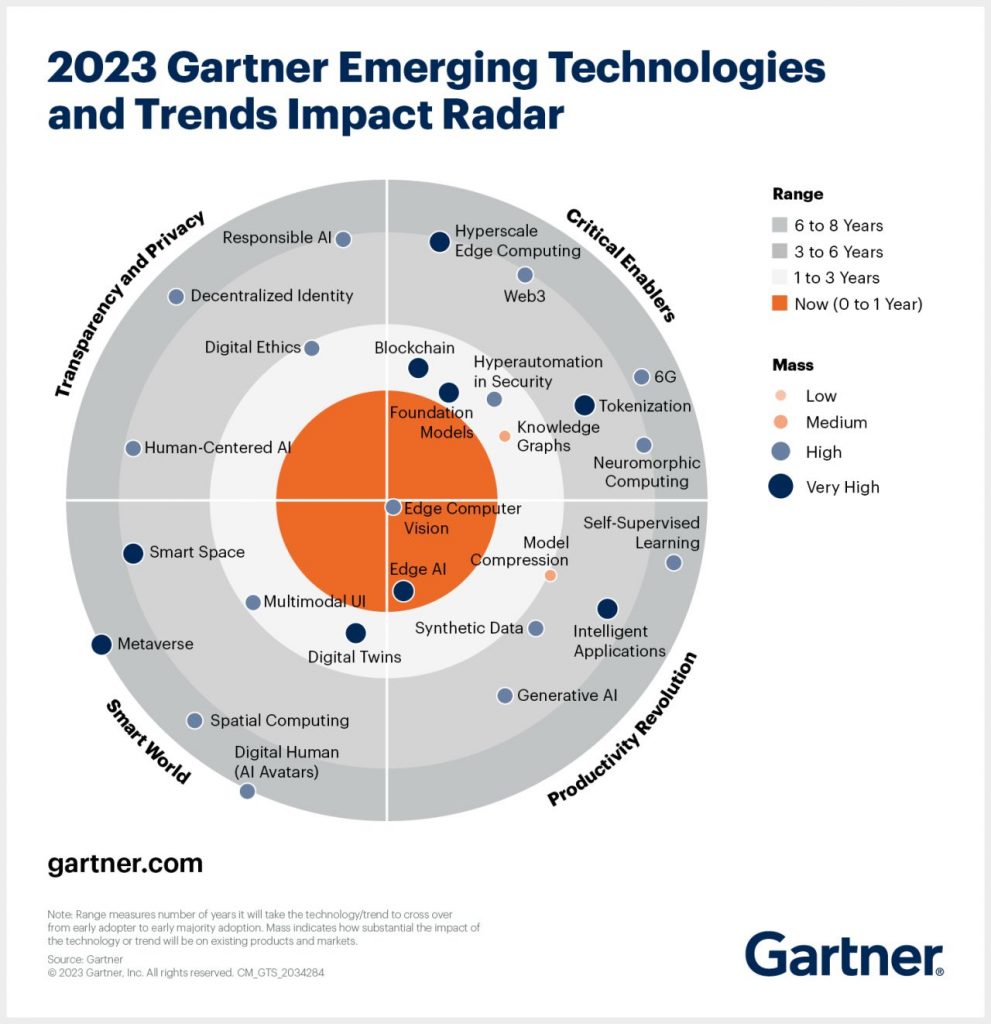
Gartner Impact Radar 2022: A Guide to Emerging Technology Trends
The Gartner Impact Radar for 2022 offered organizations a way to scan the technology landscape and consider which emerging developments could affect business and society. Rather than presenting a step-by-step adoption plan, an impact radar is a visual framework for comparing technologies, their potential influence, and the time it may take for that influence to become significant.
Because the radar reflects Gartner’s research and expectations at the time, it is best read as a snapshot of 2022—not as a guarantee of what happened next. Technology adoption depends on practical factors such as cost, regulation, infrastructure, customer needs, and organizational readiness.
What Is the Gartner Impact Radar?
Gartner’s Impact Radar is designed to help business and technology leaders look beyond established tools and consider developments that may shape the future. It groups emerging technologies and trends into a visual overview, making it easier to discuss possible opportunities, risks, and planning horizons.
The radar is useful for strategic conversations, but it is not a checklist. A technology’s appearance on the radar does not mean every organization should invest in it. Leaders need to assess whether a trend is relevant to their industry, customers, and business goals.
Technology Themes in the 2022 Landscape
The technology conversation in 2022 included several fast-moving areas. These themes help explain the kinds of changes organizations were evaluating, though they should not all be treated as direct recommendations from Gartner’s radar.
Artificial Intelligence and Automation
AI continued to expand beyond analytics and prediction into activities such as language processing, content generation, and decision support. Automation also remained a priority as organizations looked for ways to streamline operations and reduce repetitive work. These capabilities raised questions about data quality, accuracy, accountability, and the role of human review.
Immersive Digital Experiences
Interest in the metaverse and other immersive experiences brought renewed attention to virtual environments, augmented reality, digital identities, and persistent online spaces. In 2022, many applications were still experimental. Businesses had to weigh the potential for new forms of collaboration, training, and customer engagement against uncertain demand and implementation costs.
Web3, Digital Assets, and Decentralization
Blockchain-based services, non-fungible tokens, and decentralized applications were prominent topics. Supporters saw opportunities for new ways to represent ownership and coordinate activity online. At the same time, volatility, security concerns, regulation, and questions about practical value made careful evaluation essential.
Cloud, Edge, and Connected Systems
Cloud computing remained central to digital transformation, while edge computing offered ways to process information closer to where it was generated. Connected devices and intelligent systems could support faster responses and new services, but they also increased the importance of cybersecurity, reliable connectivity, and sound data governance.
How Organizations Can Use an Impact Radar
An impact radar can be a starting point for structured discussion. Organizations can use it to:
- Identify relevant trends: Focus on technologies connected to business objectives, customer needs, or operational challenges.
- Set an exploration horizon: Separate technologies worth monitoring from those ready for a limited pilot or broader deployment.
- Run small experiments: Test assumptions with bounded projects before committing significant resources.
- Assess risks early: Consider security, privacy, compliance, ethics, skills, and vendor dependence.
- Review decisions regularly: Revisit priorities as evidence, costs, regulations, and technology capabilities change.
Why the Radar Should Not Be Treated as a Forecast
Emerging-technology assessments involve uncertainty. Some technologies develop more slowly than expected; others find useful applications sooner than anticipated. A position on a radar cannot account for every organization’s circumstances, and a promising technology may still fail to deliver a clear return on investment.
It is also important to distinguish a technology’s potential impact from its readiness. A development can be highly influential over the long term while remaining immature or unsuitable for immediate adoption. Practical decisions should combine external research with internal expertise, customer feedback, and measurable business outcomes.
Conclusion
The Gartner Impact Radar 2022 provides a historical lens on how organizations were thinking about emerging technology during a period of rapid digital change. Its greatest value is not in predicting a single future, but in encouraging leaders to ask better questions: Which developments matter to our organization? What evidence would justify a pilot? What risks need to be managed? And what capabilities should we build now?
Used as one input among many, an impact radar can help turn broad technology trends into a focused, ongoing process of evaluation and learning.
5 Tips for Using the Gartner Impact Radar 2022 Effectively
- Use the radar to spot emerging technologies, not as a guaranteed forecast.
- Check each technology’s expected time to impact before prioritizing it.
- Compare radar insights with your industry’s needs and constraints.
- Validate Gartner’s predictions with current market evidence.
- Revisit the radar regularly as technologies and priorities change.
Use the radar to spot emerging technologies, not as a guaranteed forecast.
Use the Gartner Impact Radar 2022 as a guide to spot emerging technologies and start informed conversations about their potential, not as a guaranteed forecast. Trends can develop faster or slower than expected, and their value depends on your organization’s goals, resources, and market. Evaluate each technology with current evidence, consider its risks, and test promising ideas on a small scale before making major investments.
Check each technology’s expected time to impact before prioritizing it.
Before prioritizing a technology on the Gartner Impact Radar 2022, check its expected time to impact. A trend that may shape your industry in the near term could call for immediate research or a small pilot, while one expected to take longer may be better suited to ongoing monitoring. Aligning your plans with the likely time horizon helps focus resources, set realistic expectations, and avoid investing too early—or overlooking a change that is approaching quickly.
Compare radar insights with your industry’s needs and constraints.
When using the Gartner Impact Radar 2022, compare its insights with your industry’s specific needs and constraints rather than treating every trend as a priority. Consider factors such as customer expectations, regulations, existing technology, budget, workforce skills, and risk tolerance. A technology that could create significant value in one sector may be impractical or premature in another, so use the radar to guide questions and research—not to replace your organization’s own judgment.
Validate Gartner’s predictions with current market evidence.
Validate Gartner’s predictions in the 2022 Impact Radar against current market evidence before making investment decisions. The report reflects expectations at a particular point in time, and technologies may mature faster or slower than predicted—or fail to gain broad adoption. Review recent adoption data, customer demand, competitor activity, regulatory changes, and real-world case studies to see whether a trend is becoming relevant to your organization. This helps turn Gartner’s insights into informed planning rather than treating them as guarantees.
Revisit the radar regularly as technologies and priorities change.
Revisit the Gartner Impact Radar regularly as technologies mature, new developments emerge, and your organization’s priorities shift. A trend that once seemed distant may become relevant sooner than expected, while another may lose importance or prove less practical. Reviewing the radar alongside current business goals, risks, and evidence helps keep technology plans focused and up to date.