
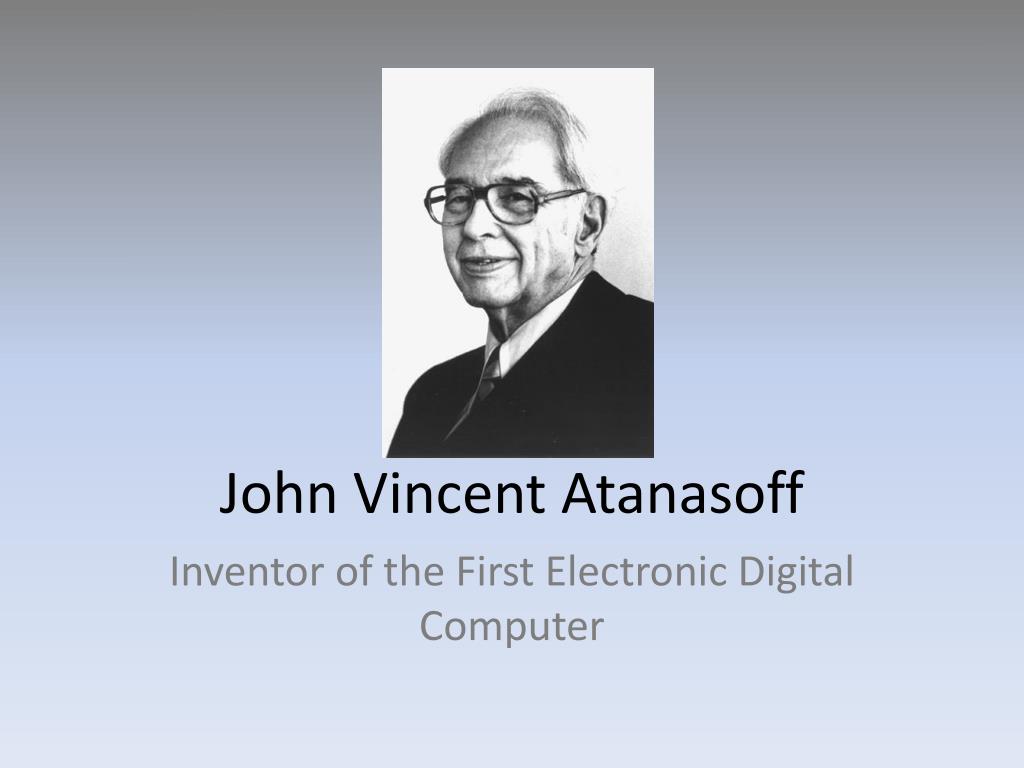
John Atanasoff: A Pioneer of Electronic Computing
John Vincent Atanasoff was an American physicist and inventor whose work helped shape the history of the computer. At Iowa State College, now Iowa State University, he developed an early electronic digital calculating machine with graduate student Clifford Berry. Known as the Atanasoff-Berry Computer, or ABC, the machine introduced ideas that would become important in later computing.
Early Life and Education
Atanasoff was born on October 4, 1903, in Hamilton, New York. His father, Ivan Atanasoff, had emigrated from Bulgaria, and his mother, Iva Lucena Purdy, was a mathematics teacher. Atanasoff showed an early interest in mathematics and science. He studied electrical engineering at the University of Florida, earning his bachelor’s degree in 1925, and later completed graduate studies in mathematics and physics. He received his doctorate in theoretical physics from the University of Wisconsin–Madison in 1930.
After earning his doctorate, Atanasoff joined the faculty at Iowa State College. His research involved complex mathematical calculations, and he became increasingly frustrated with the mechanical calculators available to help with the work. He began considering whether electronics could provide a faster and more reliable solution.
The Atanasoff-Berry Computer
Atanasoff developed the central concepts for his computer in the late 1930s. In 1939, he and Clifford Berry began building a prototype. The resulting machine, completed in 1942, was designed to solve systems of linear equations.
The ABC used electronic components and represented numbers in binary, using the digits 0 and 1. It also stored data as electrical charges on capacitors and used a process to refresh those charges. These techniques addressed practical challenges in electronic computing, including how to represent and retain numerical information.
The ABC was not a general-purpose computer in the modern sense. It was built for a specific mathematical task, and it did not have a stored program that could be changed to perform a wide range of operations. Its parts were also not fully integrated into a reliable, finished machine. Nevertheless, it was an important experimental design that demonstrated the potential of electronic digital computation.
Influence and Recognition
During a 1941 visit to Iowa State, physicist John Mauchly saw Atanasoff’s work and discussed computing with him. Years later, Mauchly became a key figure in the development of the ENIAC, one of the first large-scale electronic digital computers. The extent to which Atanasoff’s ideas influenced Mauchly became a subject of legal dispute.
In 1973, a U.S. federal court ruled in Honeywell v. Sperry Rand that the patent associated with the ENIAC was invalid. The decision concluded, among other things, that the ENIAC’s subject matter had been derived from Atanasoff’s work. The ruling brought renewed public attention to Atanasoff and the ABC. Historians continue to examine the contributions of many researchers and engineers whose work formed the foundations of computing.
Atanasoff’s achievement is best understood as a significant early step rather than the invention of every feature of the modern computer. His work with Berry showed how electronic circuits could be used for digital calculation and helped establish ideas that later computer designers would develop further.
Later Years and Legacy
During World War II, Atanasoff worked on defense-related engineering projects. He later pursued a career in government and industry, including work in research and consulting. Although the ABC received limited recognition during its early years, Atanasoff eventually received numerous honors for his contributions to computing. He died on June 15, 1995, in Frederick, Maryland.
Today, John Atanasoff is remembered as a major pioneer in computer history. The ABC stands as evidence of the creativity and experimentation that marked computing’s early development—and of the people whose inventive work helped make the digital age possible.
Exploring the Legacy of John Atanasoff: Key Questions and Answers
- Who was John Atanasoff?
- What is John Atanasoff best known for?
- What was the Atanasoff-Berry Computer (ABC)?
- When did John Atanasoff build the ABC computer?
- How did the Atanasoff-Berry Computer work?
- Was the ABC the first electronic digital computer?
- What was Clifford Berry’s role in developing the ABC?
- How did John Atanasoff influence the development of later computers?
- What awards and recognition did John Atanasoff receive?
Who was John Atanasoff?
John Atanasoff was an American physicist and inventor best known for developing the Atanasoff-Berry Computer with graduate student Clifford Berry in the late 1930s and early 1940s. Designed to solve systems of linear equations, the ABC used electronic components and binary representation, making it an important early step in the development of digital computing. Atanasoff’s work helped shape computer history, though the ABC was a specialized machine rather than a general-purpose computer.
What is John Atanasoff best known for?
John Atanasoff is best known for developing the Atanasoff-Berry Computer (ABC) with graduate student Clifford Berry at Iowa State College in the late 1930s and early 1940s. Designed to solve systems of linear equations, the ABC used electronic components and binary numbers, pioneering ideas that helped shape the development of digital computing.
What was the Atanasoff-Berry Computer (ABC)?
The Atanasoff-Berry Computer (ABC) was an early electronic digital machine designed by physicist John Atanasoff and built with graduate student Clifford Berry at Iowa State College between 1939 and 1942. It was created to solve systems of linear equations, using electronic circuits, binary numbers, and capacitors to store data. The ABC was not a general-purpose computer and did not run stored programs, but it demonstrated important ideas that influenced the development of later electronic computers.
When did John Atanasoff build the ABC computer?
John Atanasoff and graduate student Clifford Berry began building the Atanasoff-Berry Computer (ABC) in 1939. They completed the machine in 1942. Designed to solve systems of linear equations, the ABC was an early electronic digital computer, though it was built for a specific task rather than general-purpose computing.
How did the Atanasoff-Berry Computer work?
The Atanasoff-Berry Computer (ABC) used electronic circuits and binary numbers—represented as 0s and 1s—to solve systems of linear equations. Vacuum tubes handled logical operations, while electrical charges stored on capacitors mounted on rotating drums held numerical data; the charges had to be refreshed as the drums turned. Information was entered and read using punched cards. Unlike a modern computer, the ABC was designed for a specific mathematical task rather than running stored programs for many different purposes.
Was the ABC the first electronic digital computer?
The Atanasoff-Berry Computer (ABC) is often described as the first electronic digital computer because it used electronic circuits, binary arithmetic, and electronic memory to solve mathematical problems. However, it was designed for a specific task—solving systems of linear equations—and could not be programmed to perform a broad range of jobs like later general-purpose computers. So whether it was “the first” depends on the definition: the ABC was an important early electronic digital computer, while machines such as ENIAC are often credited as the first general-purpose electronic digital computers.
What was Clifford Berry’s role in developing the ABC?
Clifford Berry was John Atanasoff’s graduate student and close collaborator in developing the Atanasoff-Berry Computer (ABC). Bringing strong practical engineering skills to the project, Berry helped design and build the machine’s electronic circuits and key components, turning Atanasoff’s ideas into a working prototype. The computer was named for both men in recognition of their joint contribution.
How did John Atanasoff influence the development of later computers?
John Atanasoff influenced later computer development by demonstrating key ideas in the Atanasoff-Berry Computer (ABC), including electronic digital calculation, binary numbers, and capacitor-based memory that required periodic refreshing. His work helped establish that electronic circuits could perform mathematical computations, and it became part of the historical and legal debate surrounding the development of later machines such as ENIAC. The ABC was a specialized calculator rather than a general-purpose computer, but its ideas contributed to the foundations on which subsequent computer designs were built.
What awards and recognition did John Atanasoff receive?
John Atanasoff received several honors for his pioneering work in electronic computing. In 1985, Bulgaria awarded him the Order of Saints Cyril and Methodius, First Class, one of the country’s highest distinctions. In 1990, U.S. President George H. W. Bush presented him with the National Medal of Technology in recognition of his contributions to computer science. His legacy is also honored at Iowa State University, where the Atanasoff-Berry Computer was developed and a campus building bears his name.